
Play/Pre School vs Kindergarten – What’s the Difference?
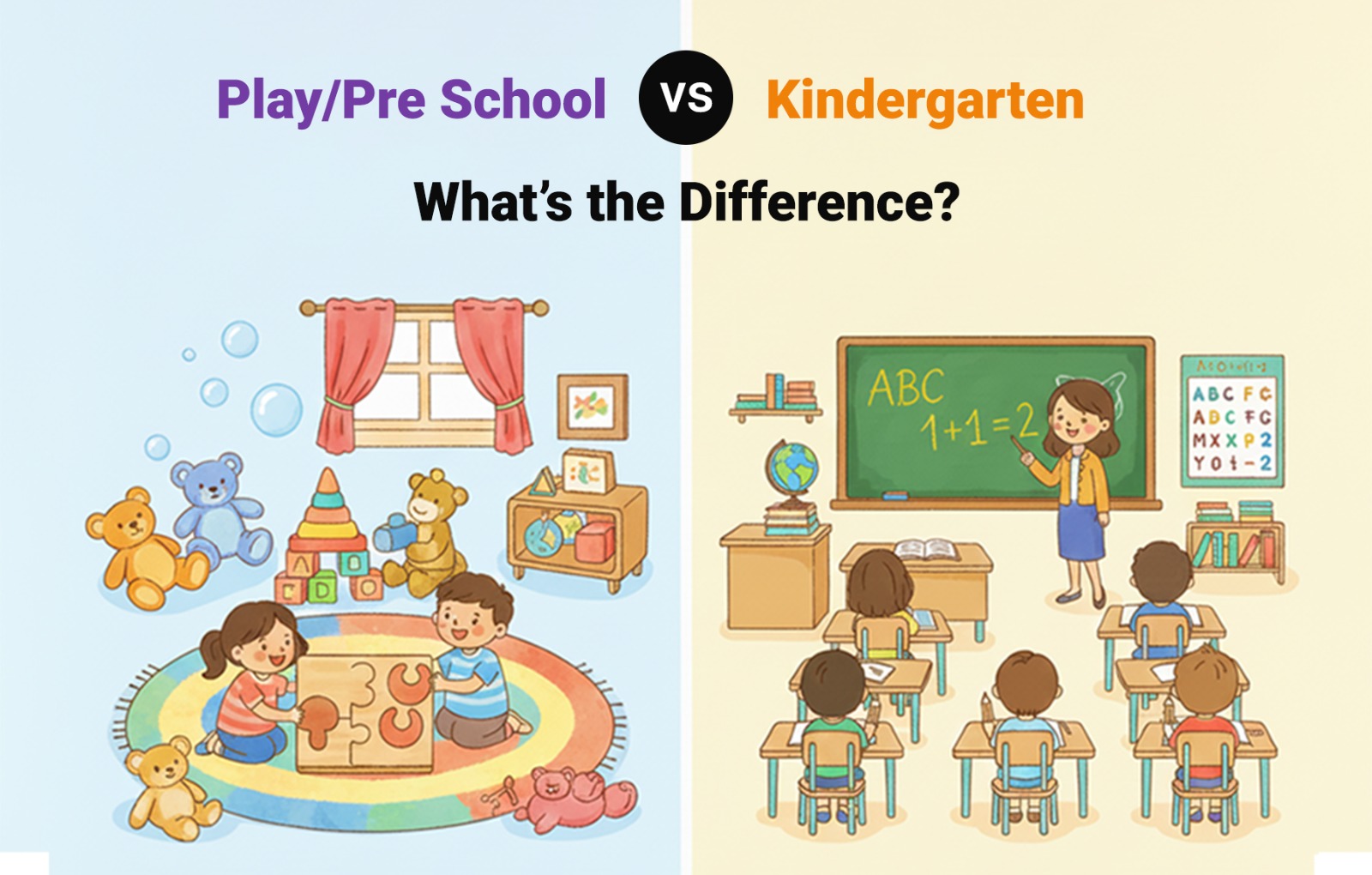
Play/Pre School vs Kindergarten – What’s the Difference?
Introduction
When parents begin exploring early education options, they often come across two terms that sound similar — Play School (or Pre School) and Kindergarten. While both play important roles in a child’s early learning journey, they differ in age group, curriculum style, teaching approach, and developmental goals.
Understanding these differences helps parents choose the right starting point and support their child through each stage of development.
What Is a Play School or Pre School?
A Play School / Pre School is a child’s first introduction to structured learning. Typically designed for children aged 2 to 4 years, it focuses on play-based, sensory, and experiential learning.
Key Characteristics of Play / Pre School
- Focus on sensory, motor, and emotional development
- Learning through play, music, movement, stories, and hands-on activities
- Shorter school hours and a flexible schedule
- Builds confidence, curiosity, and social skills
- Uses methodologies like Playway and Montessori
Objective: Create a nurturing environment where children explore, express, and adapt comfortably to group settings.
What Is Kindergarten?
Kindergarten is the next step after Pre School, typically for children aged 4 to 6 years. It serves as the bridge between early learning and formal schooling, introducing structured concepts in age-appropriate ways.
Key Characteristics of Kindergarten
- Emphasis on early literacy (phonics, reading) and numeracy
- Introduction to structured subjects like language, math, and general awareness
- Development of writing and comprehension
- Activities include problem-solving, phonics, science exploration, and pre-academics
- Prepares children for Grade 1
Objective: Build academic readiness while supporting emotional, cognitive, and social development.
Play School vs Kindergarten – A Quick Comparison
| Aspect | Play/Pre School | Kindergarten |
| Age Group | 2 – 4 years | 4 – 6 years |
| Learning Focus | Play-based, exploratory | Academic readiness |
| Approach | Informal, sensory, activity-driven | Structured lessons + learning outcomes |
| Skills Built | Social, motor, emotional | Reading, writing, cognitive |
| Curriculum Style | Montessori / Playway | Semi-formal Pre-primary curriculum |
| Main Purpose | Adaptation & foundational development | Preparing for Grade 1 |
How These Two Stages Work Together
Play School and Kindergarten are not alternatives — they are complementary learning stages.
- Pre School helps children adapt socially, emotionally, and behaviorally.
- Kindergarten builds on this foundation to introduce structured academics.
Together, they support holistic and 360-degree development, preparing children for lifelong learning.
Which Is Right for Your Child?
Choose a Play School if your child:
- Is between 2–4 years,
- Needs support in social and emotional development,
- Is taking their first step into group learning.
Choose Kindergarten if your child:
- Is between 4–6 years,
- Is ready for structured learning,
- Needs preparation for Grade 1 and formal academics.
The right environment ensures your child grows confidently at every stage.
First School’s Early Learning Framework (Across All Locations)
At First School, children experience a thoughtfully designed early learning journey across:
- Play School
- Pre School (Nursery)
- Kindergarten (LKG & UKG)
With a strong emphasis on:
- Holistic development
- 360-degree learning approach
- Interactive teaching
- Parent partnership
- Nurturing, child-friendly environments
Parents can explore the programmes at their nearest branch:
First School – Madipakkam
First School – Nanganallur
First School – Manapakkam
Each location offers structured programmes tailored to build confidence, curiosity, and school readiness in young learners.
Conclusion
Both Play/Pre School and Kindergarten are vital steps in a child’s early education. While Play School lays the foundation through exploration and social development, Kindergarten strengthens academic readiness and prepares children for formal schooling.
Choosing the right stage based on your child’s age and readiness ensures they grow with joy, confidence, and balanced development.
To learn more or schedule a school visit, explore our nearest First School location today.